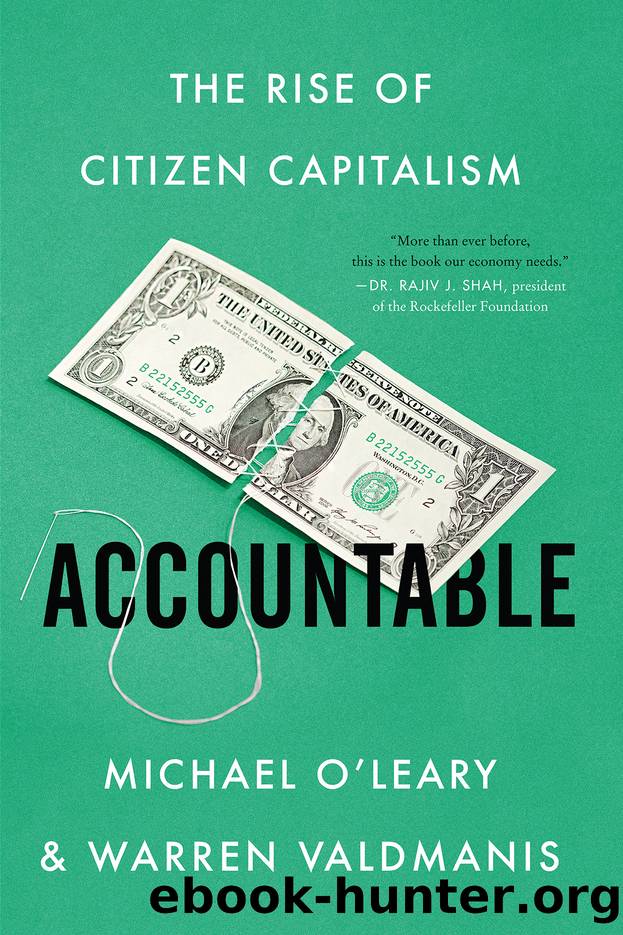
Accountable by Michael O'Leary
Author:Michael O'Leary
Language: eng
Format: epub
Publisher: HarperCollins
Published: 2020-08-18T00:00:00+00:00
Building Finance Around Stewardship and Accountability
In 2004, the investor Richard Perry owned shares in King Pharmaceuticals. Perry thought it was about to be acquired by rival Mylan Laboratories, which would be very good for him. Unfortunately, Mylan shareholders weren’t so sure that buying King would be very good for them. So Perry did something remarkable: he bought 9.9 percent of Mylan shares with the intent of pushing the acquisition through. His interests were not aligned with those of most Mylan shareholders, though. That was because when he bought 9.9 percent of Mylan, he simultaneously entered into a financial contract so that he would actually make money if the Mylan stock price declined. He had the power to vote the shares in favor of acquiring King, and if it ended up hurting Mylan, he would profit twice over.75
This is our financial system at its worst—a casino entirely divorced from any sense of stewardship or accountability. Today, no legal duty binds shareholders to act in the best interests of the companies they invest in.76 This has to change.
The United Kingdom offers one path we might take. In July 2010, it introduced a Stewardship Code for investors that has since been adopted in one form or another in twenty other countries.77 The code sets a high benchmark for stewardship “as the responsible allocation, management and oversight of capital to create long-term value for clients and beneficiaries leading to sustainable benefits for the economy, the environment and society.”78
Updated in 2019, the code has the aim of “making investors’ stewardship efforts more transparent, thereby making them more accountable.”79 It asks investors to “systematically integrate stewardship and investment, including material environmental, social and governance issues, and climate change, to fulfill their responsibilities.”80 It promotes active engagement with companies and a responsibility to ensure a well-functioning financial system.
“Signatories are now required to explain their organisation’s purpose, investment beliefs, strategy and culture and how these enable them to practice stewardship,” the code stipulates. “They are also expected to show how they are demonstrating this commitment through appropriate governance, resourcing and workforce incentives.”81
The UK Stewardship Code is still voluntary—a “comply or explain” regulation with no teeth. “If the code remains simply a driver of boilerplate reporting, serious consideration should be given to its abolition,” wrote one critic.82 Nonetheless, we think it provides a helpful model of how we might make the duties between corporations and investors reciprocal—by insisting that investors who vote shares on corporate resolutions be duty bound to act in the long-term best interests of those corporations.
A Stewardship Code would be a great first step—but further steps are required to align disclosures, compensation, and taxes with the long-term public interest.
First: board members themselves should better represent the stakeholders they are responsible for, and they should be elected for three-year terms rather than annually. Longer cycles would give shareholders fewer board elections to focus on each year and the ability to assess each one more thoughtfully. Rather than our current system, which vastly favors incumbents, all nominees with
Download
This site does not store any files on its server. We only index and link to content provided by other sites. Please contact the content providers to delete copyright contents if any and email us, we'll remove relevant links or contents immediately.
Time Management Made Easy: How to Cultivate New Habits, Improve Productivity and Get Things Done by Joshua Strachan(2417)
The 7 Habits of Highly Effective People by Stephen R. Covey & Sean Covey(2267)
The Concise Laws of Human Nature by Robert Greene(1913)
Doesn't Hurt to Ask by Trey Gowdy(1637)
Primal Leadership by Daniel Goleman(1283)
Hook Point: How to Stand Out in a 3-Second World by Brendan Kane(1246)
Don't Sweat the Small Stuff...and It's All Small Stuff by Richard Carlson(1121)
HBR's 10 Must Reads 2021 by unknow(1096)
The Power of 100! by Shaun King(1096)
Amazon Unbound by Brad Stone(1045)
100 Things Successful People Do by Nigel Cumberland(1030)
Master of One by Jordan Raynor(1008)
HBR's 10 Must Reads 2021 by Harvard Business Review(1007)
The Job Closer by Steve Dalton(993)
Lives of the Stoics by Ryan Holiday & Stephen Hanselman(969)
Declutter Your Mind: A step by step guide to learn to control your thoughts, stop worrying, relieve anxiety and eliminate panic attacks and negative thinking by Mia Chandler(968)
Conflicted by Ian Leslie(872)
The Book of Hope by Jane Goodall(872)
Coders at Work: Reflections on the craft of programming by Peter Seibel(847)
